Jack Cooper Central Railroad of New Jersey Locomotive Engineer by Ron Eskesen
- Fred Heilich

- Mar 22, 2025
- 7 min read
Fellow Dunellenite and NJ Exempt Fireman, Ron Eskesen has submitted the following raw information for a blog on his grandfather, Jack Cooper who was a Central Railroad of New Jersey locomotive engineer.
John and Mary Cooper lived in Dunellen and had 5 children. William A. was a fireman on a Jersey Central tugboat. George was a laborer on the CRR of NJ during WWI 1917-1918. Richard H. was an engineer on the CRR of NJ. John Joseph, Ron's grandfather, was an engineer on the Central Railroad of New Jersey. Daughter Mame was married and a housewife.
Ron's great grandfather John (the elder) supervised the Rice farm in Green Brook that went from Warrenville Rd to Sebrings Mill Rd. Prior to 1899, he was employed as a hostler, moving trains and engines, for the CRR of NJ in the Dunellen roundhouse and yard.
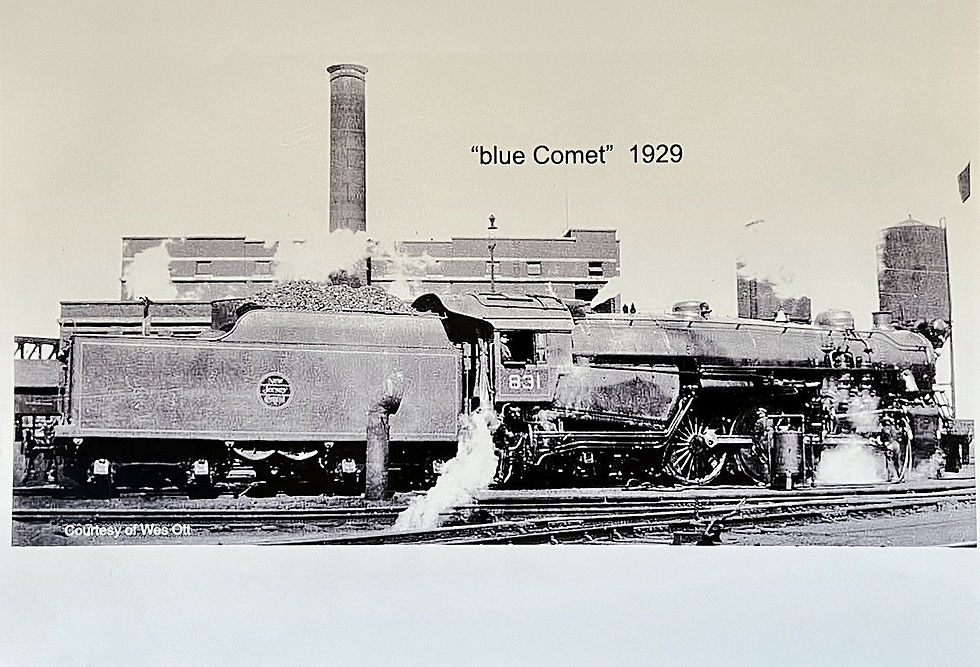
John J. started his career on the CRR of NJ on Jan 1915-Aug 1924 as a fireman in Jersey City, NJ. In August 1924 he was promoted to engineer on the railroad until Dec 1936. He retired April 24, 1959. During his career as a CNJ engineer he ran on the premier train "The Blue Comet" from Jersey City to Atlantic City and return.
Ron has provided of the following photos and captions on his grandfather's career on the CNJ including those from the late Wes Ott's collection except where noted.

The following are a sample of what the Dunellen Roundhouse looked from the early 1900s to before the grade separation in 1954.


When Jack Cooper was a child, he and other kids would venture to nearby Middlesex and hang out with heavyweight boxer Bob Fitzsimmons. Fitzsimmons had a boxing ring in his garage, and the kids would spar with him until he got tired. He would then throw the kids in a large hay pile.
Ron's grandfather recalled Fitzsimmons doing his roadwork and walking his pet Lion along North Ave.

Following are several of John J Cooper's CNJ service records.


Jack Cooper's photo with his engines appeared in several newspaper articles.


On or about 1931 Jack Cooper was transferred from Dunellen to E-port in Elizabeth, NJ with his family. The 1930 Census reports that he was an engineer with a city address in Elizabeth, NJ
During the Depression, Jack Cooper made frequent trips through the New Jersey Pine Barrens on the Central RR of New Jersey crack passenger train, 'The Blue Comet, from Jersey City to Atlantic City and return. During that time, he encountered many poor people along the line.
On several occasions, when making the stops along the line to Atlantic City, people would
come up to the engine asking for a bucket of coal to heat their stoves. In return the people would give him and the crew homemade pies. This was a rules violation for which he would have been written up.


In the mid 1940s the US Army took a large tract of land in Edison, NJ and Piscataway, NJ to create the largest troop staging area in the US for WWII. This was the first such installation built. Ron was told that his grandfather Jack Cooper took the first troop out of Camp Kilmer to Jersey City, NJ.

Post WWII Jack Cooper had the honor of carrying the President of Lionel Trains, Joshua Lionel Cowen, in his engine. Mr. Cowen subsequently began putting the names of cities and towns along the CNJ on the sides of the Lional passenger cars. Some of the towns, Plainfield, Westfield, and Cranford, were shown in the catalogs. Unfortunately, one for Dunellen was not created.
After the ride in the engine, Mr. Cown presented him with a miniature gold locomotive tie tack. Ron remembers seeing it as a child and a family member may still have it.

Around 1935 Jack Cooper and family moved back to the Dunellen area. Jack's daughter Mary met Bernard Eskesen. They eventually got married and lived in an apartment over Stanson's Bakery. Eventually the Coopers moved into a duplex in Dunellen and the Eskesen's with young Ron moved into the adjoining unit circa 1940.
This house was about 150 yards from the CNJ Right of Way. When Jack Cooper was working, he would stop his engine and his wife and Ron's mother with Ron in toe would hand up his dinner. The stop was just before the Grove St crossing.
Jack Cooper always liked the Dunellen Rescue Squad. In the 1940s the Rescue Squad was building their new headquarters a few doors down from his home. On weekends he would help the volunteers erect their new building, helping with block and cement work.
The building was dedicated on Sunday December 7th,1941 before the news of the bombing of Pearl Harbor broke. He and the Squad members met on Sundays to play cards at the hall.
While Ron's father, Bernie, was in the service, Jack became Ron's father figure. Using his railroad pass and knowing the other engineers and conductors, he frequently took Ron on train trips mostly to the Jersey Shore.

In the early-1950s before the track elevation in Dunellen, Ron's grandfather asked if he wanted to ride on his engine, and I could bring a friend. Ron had a good friend, Phil Cummings. A date and time were set for the trip. They met Jack Cooper with his engine at Prospect Ave, climbed aboard, and headed West as far as Raritan. The engine was turned, and they returned to Dunellen. It was the trip of a lifetime and talked about for years to come.
In 1953, there was a fatal train accident at the Washington Ave. crossing during a weekday when several high school students tried to get under a stopped train, and several were killed. This was the final push to get the railroad grade separation done through Dunellen. The following newspaper photos show the work underway.


The grade separation work was complete enough that the first Budd RDC came into Dunellen on January 24th,1955, with Jack Cooper at the controls. He was greeted by family members and the Dunellen Town Fathers.


During his time as Fireman and Engineer on the Jersey Central, jack Cooper would have had a set of railroad switch keys for his territory. Following are 4 keys from his collection would have been the ones he used when running 'The Blue Comet'. They are for the NY&LB (New York & Long Branch, CRR of NJ, PRR (Pennsylvania), and P&R (Reading).

On the day of the CNJ Newark Bay Draw Bridge wreck in1958 Jack Cooper took his Passenger train over the Bayonne bridge. He said he took the train over the bridge with no incident. The bridge was open to let a ship pass under it. The bridge never returned to its rail crossing position. The next train p[unged off the bridge into the Newark Bay carrying 48 people to their death.
Cooper always talked about the incident and how lucky he was. He was quite upset for a long time over the loss of life of the passengers and his coworkers.
Ron recalled front pages of newspapers with photos of the passenger coaches being lifted out of the water with several bodies hanging out the windows.
Rumor had it that at the time gamblers played the numbers with the bookies using coach numbers of the fatal coaches shown in the newspapers. The numbers came in and set the bookies back for a while.

Railroad employees were issued annual passes for use over their road and for travel on other rail lines. Here is one of Jacke Cooper's annual passes effective until December 31, 1979. Also, for his years of service, he was a lifetime Honorary Member of the Brotherhood of Locomotive Engineers. a copy is also provided.


On April 27th, 1977, John J Cooper boarded his eternal engine for his Westbound Trip with his hand steady on the throttle for eternity.

Dunellenites John Triolo and Liz Marren-Licht with Images of America published an 'Images of America Dunellen, NJ' book with historical postcards and images of Dunellen through the years. The Family of John J Cooper were honored by having a photo of him on the face cover seen sitting on the front running step of CNJ Camelback #777.


Comments